Privacy by design
Message content remains end-to-end encrypted between participating clients using Matrix-compatible cryptography.
End-to-end encrypted messaging.
Built for AWS. Connected to Matrix.
A complete messaging platform in your AWS account, with a dedicated web client and standard Matrix federation.
Messages and attachments encrypted on the client.
 Diaktor
Synapse and other Matrix homeservers. Standard Matrix clients.
Diaktor combines content privacy, elastic operation, immediate delivery, open interoperability, and customer control in one deployable communication product.
Message content remains end-to-end encrypted between participating clients using Matrix-compatible cryptography.
Lambda, DynamoDB, and managed AWS services respond to workload without estimating a fixed runtime footprint before demand arrives.
AppSync Events delivers updates over WebSockets instead of maintaining the traditional
long-polling /sync channel, while client operations retain Matrix-native
contracts and event formats.
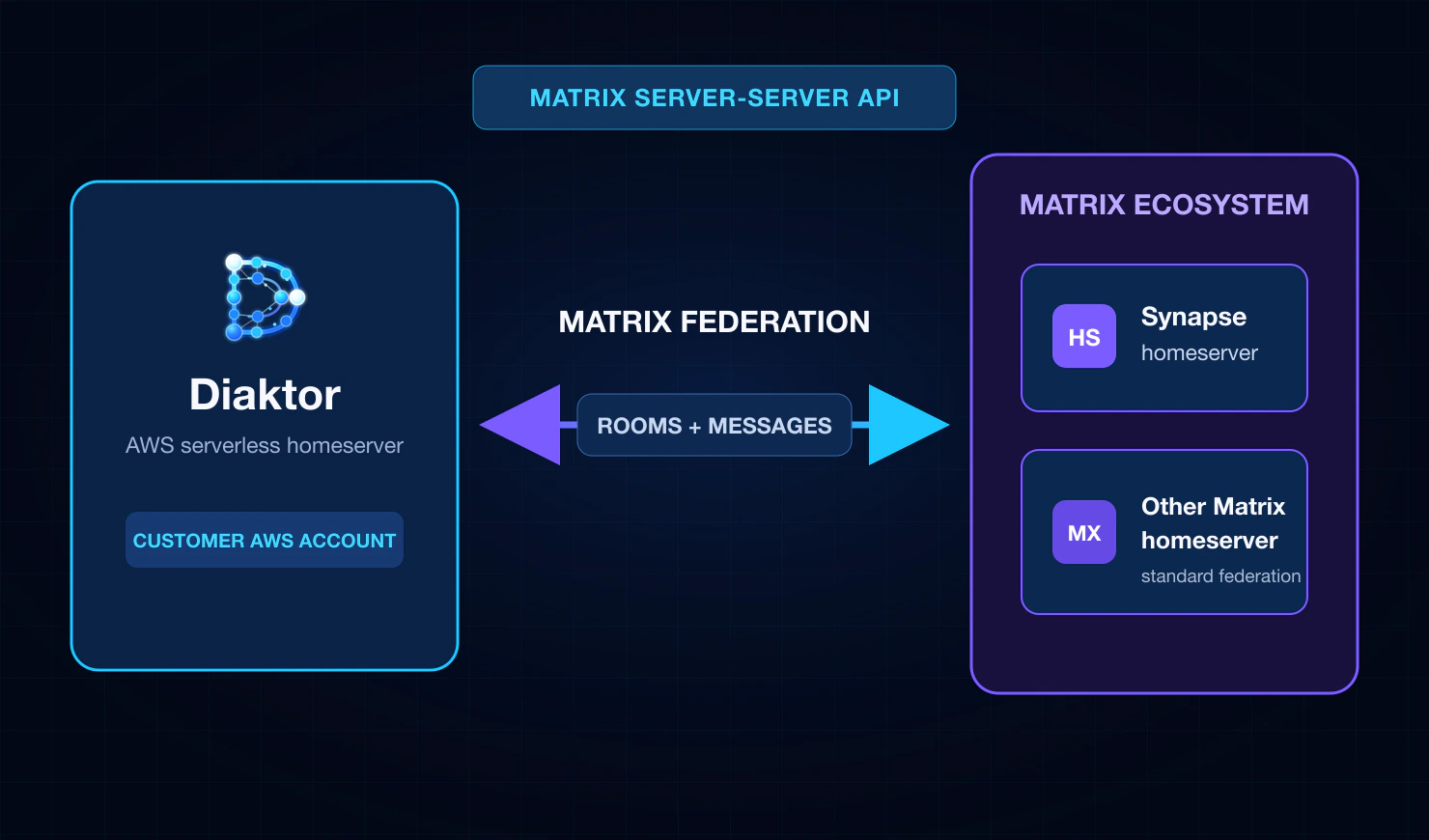
Server-server compatibility lets rooms and messages federate with Synapse and other Matrix homeservers.
Runtime components and data stores run in a dedicated customer AWS account for clearer control, isolation, and operational ownership.
The Diaktor web client uses matrix-sdk-crypto for Matrix-compatible E2EE.
Message content and attachments stay encrypted between participating clients, including
when rooms cross organizational boundaries through federation.
Encryption and decryption happen at participating clients rather than in the serverless messaging core.
Matrix-compatible encrypted content remains protected as events move between Diaktor, Synapse, and participating Matrix clients.
E2EE protects message content and attachments. Endpoint security, identity, metadata, and access governance remain explicit parts of each deployment's security model.
Diaktor implements the standard Matrix server-server API directly, so rooms and messages
can move across organizational boundaries with Synapse and other homeservers without
protocol conversion. Implemented client operations use standard Matrix client-server
contracts and event formats; only synchronization moves from long-polling /sync
to AppSync Events WebSocket push, which requires the Diaktor web client.
Diaktor runs on managed AWS services that respond to workload instead of relying on permanently provisioned compute. Lambda, AppSync Events, and DynamoDB avoid sizing peak capacity in advance and maintaining a traditional messaging runtime around the clock.
The architecture can scale from idle to high demand within configured AWS quotas and workload limits, while push delivery keeps the client experience reactive.
See the technical architecture
Build specialized messaging products with your own clients, identity flows, and workflows. Diaktor provides E2EE, real-time delivery, Matrix federation, and AWS serverless infrastructure.
A TI-Messenger-style healthcare product could use Diaktor as an alternative foundation to Synapse Pro. The product would still need to meet the applicable TI-Messenger specifications and approval requirements.

Diaktor is designed and developed by devFlorence, an independent software development studio focused on senior engineering ownership, modern Java, AWS-native infrastructure, and production discipline.
devFlorence is led by Alessandro De Stasio and combines 30+ years of software engineering experience with modern Java, AWS-native infrastructure, and AI-assisted delivery under senior technical control.
Join the first group of up to five organizations deploying Diaktor in their own AWS account. Start with a free demo; deployment dates are agreed individually, subject to readiness.
€19,900 / year Includes up to 300 enabled accounts. A twelve-month commitment, paid monthly; additional accounts are priced progressively.
Bronze is the included support package for product issues during business hours.
€2,000 one-off onboarding One standard production deployment in your AWS account. Paid before work starts.
3 months of Silver support included Silver is the enhanced support package, with faster initial responses and one scheduled advisory hour per month. Bronze resumes afterwards.
Your subscription price stays the same.
10 business days to decide After handover, withdraw before the annual subscription begins. No subscription or support fees accrue during this window.
Early-access benefits apply to eligible contracts signed by 31 December 2026. Completed onboarding is non-refundable. AWS costs are separate and remain payable during the exit window. Prices exclude VAT; full terms are agreed before onboarding.
For consultants, technology providers and integrators working with organizations that need secure messaging in their own AWS account.
Discuss a partnershipAnswers to the technical and deployment questions to discuss before joining early access.
Yes. Diaktor is positioned as a serverless, AWS-native alternative to operating a traditional Synapse-style Matrix homeserver stack. Read the serverless Matrix technical guide for the operating model and compatibility boundaries.
Implemented client operations use standard Matrix client-server contracts and event
formats. Diaktor replaces only the long-polling /sync channel with AppSync
Events WebSocket push. Federation independently uses the standard Matrix server-server
API, directly and without protocol conversion.
The current product requires the Diaktor web client because Element and other standard
clients expect the HTTP long-polling /sync channel. Diaktor delivers
synchronization updates through AppSync Events WebSocket push instead.
The intended deployment model is customer-hosted: runtime services and data stores run inside the customer AWS account.
The Diaktor web client relies on matrix-sdk-crypto for Matrix-compatible
end-to-end encryption for messages and attachments. E2EE protects content between
clients; endpoint security, identity, and metadata remain separate security
responsibilities. The E2EE guide
describes that boundary in detail.
Serverless components respond to workload within configured AWS quotas and deployment limits. Diaktor does not reserve baseline application capacity before demand arrives, but it does not claim unbounded capacity.
Organizations that need private, encrypted messaging in their own AWS account and benefit from reactive delivery, elastic scale or Matrix federation. Beta deployments are planned from October 2026 for up to five organizations. Start with a free demo. Eligible early adopters receive three months of Silver support and a ten-business-day exit window after handover, with no subscription or support charges during that window. Explore the early-access offer or request a demo and a call.
Diaktor takes its name from Diaktoros, an ancient Greek epithet of Hermes, the messenger of the gods. We chose a shorter form to reflect the same purpose in modern messaging: carrying private conversations between people and across organizations.
Tell us about your use case, expected number of enabled accounts and AWS context. We will arrange a free demonstration and a call to discuss your deployment and pricing. This inquiry creates no purchase commitment.